 Printwear & Promotion The Total Promotional Package
To get the best out of any process, all must learn the intricacies of how best to work it; and dye sublimation is no different. Beppe Quaglia, founder and CEO of Virus Inks explains her pointers on how to best use the process.
In the competitive landscape of garment decoration, sublimation printing is no longer just a technological choice but a strategic asset for those aiming for peak quality and industrial scalability.
While mastering the basics is the first step, the true leap in quality lies in the granular control of variability and the adoption of rigorous standards that guarantee repeatable results.
Beyond the ICC profile
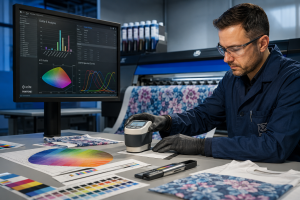
Colour management is often the critical failure point in production. For a professional operator, ICC profiles are an indispensable industrial standard to faithfully translate colours from monitor to fabric, compensating for variations between printer, ink, paper, and substrate.
To elevate quality, the goal must be achieving a Delta E value below 2, making chromatic differences practically imperceptible to the human eye. This result requires the use of a high-end spectrophotometer, such as the X-Rite i1Pro 3 Plus, an investment that pays for itself quickly by reducing waste and remakes. Equally vital is hardware monitor calibration: An uncalibrated monitor can display colours drastically different from printable ones. A modest investment for a hardware colourimeter and monthly recalibration prevents costly errors during client approval phases.

The triangle of success
Quality depends on the perfect balance of temperature, time, and pressure. Although the optimal range is between 380°F and 400°F (193°C – 204°C), precision is everything: deviations of as little as ±18°F (±10°C) can compromise colour fastness.
An often-overlooked element is pressure. The standard is 40 PSI (2.8 bar), but it must be adapted: Irregular surfaces require higher pressure, while delicate materials need reductions to avoid press marks. For high-volume industrial applications, contact time is also critical (generally 35 to 60 seconds): exceeding 60 seconds does not improve quality but increases the risk of ghosting and wastes energy. Using high-quality heat-resistant tape to secure the paper is essential for eliminating this defect.
rPET and hybrid denim
 Sustainability is now a documentable market requirement. Recycled polyester (rPET) sublimates like virgin polyester but requires technical attention: Using slightly lower temperatures (383-392°F / 195-200°C) optimises results without stressing fibres that have already undergone a recycling process. This material guarantees a 59% energy saving in production, a valuable metric for ESG-oriented brands.
For those seeking aesthetic innovation, hybrid denim (polyester warp, cotton weft) offers unique opportunities, allowing the sublimated design to create three-dimensional depth. In this case, parameters must be specific: 392°F (200°C) with a speed of 6.6ft (2m) per minute on a calendar press and a pressure of 51 PSI (3.5 bar). Conversely, printing on treated cotton remains a niche solution: Chromatic loss can reach 70% after 50 washes, compared to only 5% for polyester, making it unsuitable for industrial volumes where durability is critical.
Hybridisation and operational efficiency

The future of the sector lies in the flexibility of platforms that integrate sublimation, DTG, and DTF. The adoption of advanced hybrid ink formulations now allows switching between processes without complete system cleaning, drastically reducing downtime. For operators managing both B2B (uniforms) and B2C (on-demand personalisation), this versatility is a tangible competitive advantage.
Certified quality and process control
To professionally qualify your output, it is essential to implement fastness tests according to ISO standards. Documenting results for wash fastness (ISO 105-C06) and light fastness (ISO 105-B02) provides the objective data that global clients increasingly demand. Predictive maintenance, including monthly verification of heat press calibration via pyrometers or heat strips, ensures that excellence is not a random event but a controlled process.
Conclusion
With a global market projected to reach £20.4 billion by 2030, the opportunities for European operators are immense. Sublimation not only boasts photographic quality but also a 99.997% water saving compared to traditional dyeing, virtually eliminating VOC emissions. Success belongs to those who can combine this measurable sustainability with impeccable technical competence and investment in high-quality control equipment.