 Printwear & Promotion The Total Promotional Package
Getting the best out of dye sublimation is a juggling act, with the need to get all parameters in the ideal spots. In this column, Beppe Quaglia, CEO and president of Virus Inks, explains the best practices to achieve this goal.
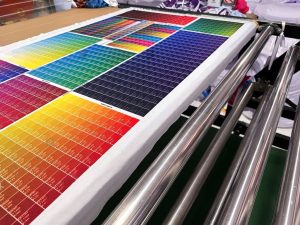
If you operate in the garment decoration sector, dye sublimation represents today one of the most strategic technologies for combining photographic quality, durability, and sustainability. But success depends on mastering precise technical parameters and implementing verified best practices. Here’s what you absolutely need to know.
Three critical parameters
The quality of your sublimation depends on the perfect balance of three variables. The optimal temperature ranges between 380°F and 400°F (193°C and 204°C). Lower temperatures produce dull colours and insufficient penetration; higher temperatures cause chromatic distortion and can damage the fabric. Scientific research confirms that this range guarantees wash fastness of 4/5 (very good) on the international scale.
The ideal contact time ranges between 35 and 60 seconds for most polyester substrates. Contrary to what many believe, extending the time beyond 60 seconds does not improve quality but increases the risk of ghosting and wastes energy. For high-volume industrial applications, optimising this parameter can mean the difference between profit and loss.
The standard pressure is 40 PSI (2.8 bar), but this value must be adapted to the substrate. Irregular surfaces require higher pressures; delicate materials require reduced pressures. Invest in a heat press with digital pressure control.
Colour management
If your colours don’t match client expectations, the problem is almost always in colour management. ICC profiles are not an optional extra for hobbyists but an indispensable industrial standard. These profiles translate colours from your monitor to the result on fabric.
Create custom profiles for every combination of materials you use. The investment in a spectrophotometer such as the X-Rite i1Pro 3 Plus pays for itself quickly by reducing waste and remakes. Professional operators achieve delta E values below 2, making chromatic differences practically imperceptible.
Don’t forget monitor calibration: an uncalibrated monitor can show completely different colours from those that can be printed. Use a hardware colourimeter and recalibrate monthly.
Sustainability
Where conventional dyeing requires 181 metric tonnes of water to dye 0.9 metric tonnes of fabric, sublimation uses only 5 ml per kg.
Water-based inks don’t release harmful organic compounds. Energy consumption is reduced by 65% compared to dyeing processes that require heating large volumes of water.
Recycled polyester (rPET) sublimates exactly like virgin polyester but requires 59% less energy in production. Brands transitioning to GRS-certified rPET respond to both regulations and aware consumers.
Materials beyond polyester
100% polyester remains the ideal substrate, but the market demands flexibility. Hybrid denim (polyester warp, cotton weft) allows unique aesthetic effects where the sublimated design creates three-dimensional depth.
For cotton, solutions exist based on polymeric coatings or powders applied to paper, but they involve compromises. Prints on treated cotton lose up to 70% of chromatic intensity after 50 washes, versus 5% for polyester.
Hybrid technologies
Systems that integrate sublimation, DTG, and DTF into a single platform are redefining the sector. They allow sublimation for light synthetics (maximum durability), DTG for dark cotton, and DTF for universal applications. The initial investment is higher, but operational flexibility can be worth it.
Advanced hybrid ink formulations recently developed can switch between processes without complete system cleaning, reducing downtime and increasing efficiency. For operators managing both B2B and B2C, this versatility is a tangible competitive advantage.
Quality control
Implement standardised fastness tests according to ISO standards. The wash test (ISO 105-C06) and light fastness test (ISO 105-B02) provide objective data on durability, something professional clients increasingly require.
Verify heat press calibration monthly using heat strips or pyrometers. Deviations of ±18°F are sufficient to cause problems. Use high-temperature resistant heat tape to secure the paper and eliminate ghosting.
Growing opportunities
The global market will reach £20.4 billion by 2030, with 11% annual growth. Asia-Pacific is growing at 12.4%, driven by e-commerce and personalisation. For European operators, verifiable sustainability of sublimation is a strategic asset in an increasingly stringent regulatory context.
Invest in technical competence, quality equipment, and robust control systems. The future of sublimation printing belongs to those who combine operational excellence with technological innovation.