 Printwear & Promotion The Total Promotional Package
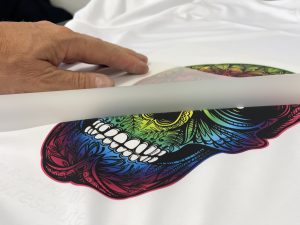
Powderless DTF ink is making strong headway through three different avenues, but which is best? Colin Marsh, CEO of Resolute, has given his two cents on the matter.
For several years, powderless DTF has been talked about as the next major development in direct to film printing. Removing adhesive powder promises cleaner production, improved print quality, softer transfers and a simpler workflow. The concept, however, is far from new.
Resolute first introduced powderless DTF printing almost seven years ago. At the time, the technology worked predominantly with polyester fabrics. Producing a commercially viable solution for cotton proved considerably more challenging, and the lack of flexibility ultimately prevented wider adoption.
We continued development rather than abandoning the concept and have since been involved in testing no fewer than five different powderless DTF ink technologies.
Today, three approaches stand out: DuPont’s P1600 jettable adhesive, NUR Ink’s two-part white ink system and a new Chinese-developed single white ink containing the adhesive within the ink itself.
DuPont: A different approach to adhesive
DuPont’s P1600 technology uses a separate jettable adhesive rather than a combination in the white ink. While technically impressive, there are practical considerations for commercial transfer producers.
Firstly, the adhesive is transparent, making it difficult to visually inspect its coverage on the reverse of the transfer.
More importantly, according to reports from multiple tests, the jettable adhesive cannot be fully cured before pressing because it needs to reactivate during the heat-pressing process. This presents a challenge for businesses producing transfers for storage or shipping to customers for pressing later. Currently, the prints require pressing within 24 hours of production or on the fly when used in an automated system called the Stomper.
NUR takes a two-part route
NUR Ink has approached the powderless DTF transfer process differently by developing a two-part white ink system.
The colours are printed first, followed by Part A and Part B, all within a single automated printing pass. The resulting powderless transfer can then be fully cured, rolled, stored or shipped before being heat pressed onto the garment.
For commercial DTF production, that flexibility is a significant advantage.
NUR currently specifies a 45-second heat-press time coupled with hot peel film, the shortest of the three powderless technologies Resolute has evaluated. The inks are competitively priced and manufactured at dual locations, helping reduce exposure to potential supply-chain disruption.
The NUR system also allows for hybrid transfer production; should you need to use a specialist adhesive powder, this can be done by simply switching on the powder hopper on the hybrid finishing unit coupled with the DTF Printer.
Perhaps more importantly, NUR’s powderless system has undergone independent durability testing by Keypoint Intelligence. Transfers were printed, pressed, washed and dried as part of the testing process, achieving excellent durability results. The full report is publicly available.
Could a single white ink change everything?
The third technology is currently undergoing development in China and potentially offers the simplest route to powderless production.
Instead of separate adhesive or two-part white channels, the adhesive is incorporated directly into a single white ink.
Potentially, this could allow a compatible DTF printer with a white ink print head to create powderless transfers without modification.
Early print and wash testing has been extremely positive, although the system currently requires the longest heat-pressing time of the three leading technologies.
Solving DTF’s hand-feel problem
The biggest reason powderless technology matters may ultimately be found on the garment rather than inside the printer.
Traditional adhesive powder contributes to the characteristic hand feel associated with many DTF transfers. Removing powder produces a noticeably softer result while maintaining excellent image quality.
In Resolute’s testing, all powderless prints have demonstrated a quality and feel comparable to DTG, while the NUR system has also delivered impressive wash durability.
For garment decorators wanting the production advantages and versatility of DTF without the heavier feel sometimes associated with conventional transfers, this represents an important step forward.
Future-proofing DTF
Most existing six-head DTF printers with two white ink feeds can use this new powderless technology, while continuing to print with CMYK or CMYKRGBO inks, providing an exceptionally wide colour gamut alongside powderless production.
As the exclusive UK dealer for the NUR powderless inks, Resolute is preparing for the technology’s UK launch at Printwear & Promotion LIVE! in February 2027.
After almost seven years of development, experimentation and testing, powderless DTF appears finally to be moving from an interesting concept towards commercial reality.
Other manufacturers will undoubtedly follow as demand develops. But right now, of the technologies tested, NUR appears to have officially won the first stage of the powderless race to the moon.