 Printwear & Promotion The Total Promotional Package
Whether you are looking to start an embroidery business from scratch or add embroidery to your existing personalisation business the same advice and tips apply to your model. Charlotte Darling, director at Amaya Sales UK, discusses.
The first question I would be asking myself is to try and define the type of work you want to carry out.
Are you looking to pick up big contracts and embroider 500 pieces of the same design and garment or will you be offering one-off gifts that require personalisation? If you are looking at bulk contracts, are you sure all the embroideries will be the same?
It is very common now for a big workwear order to all have the same logo but then every three garments to have an individual’s name or initials. So, quiz your potential customers, or do your research, as to the type of work they want you to do as this can determine the type of equipment you buy.
Embroidery options
If you had asked me to define embroidery equipment options on the market a year ago, I would have said embroidery machines fall into two clear categories – conventional or modular systems.
Conventional machines include those with a screen on the actual machine that control the set number of heads from one head up to say 12. Multi-head is what it says – a machine that has more than one head, most commonly these days between two to 12. Such a machine appears to be great to run large bulk orders. You set your design up once, frame all your garments press a button and off it goes. However, if you get a problem like a thread or bobbin break on one head then all the heads stop. If you get an order for three garments and you run them on your six-head machine, three heads will be sat doing nothing while the other three heads produce the order. If you get an order for 30 garments, but each garment requires a different name on it, then you will only be able to use your six-head machine one garment and one head at a time as all heads have to do exactly the same job.
This is where a multi-head modular system really increases your productivity and efficiency. Commonly it will be individual machines, any quantity you choose, and they are run by one PC, rather than at a screen on the machine. While a true modular system may cost more per head than the conventional multi-head machine, the benefits are huge, and a four-head modular system will produce more embroidery per hour than a conventional six-head machine so when you are comparing costs you really need to see a production calculator.
Efficiency
Why are they so much more efficient? As mentioned above a six-head system set up to run all the same design – thread break on one head, all six heads stop. Replicate this scenario on a modular system – same design on all heads, thread break on one and only that one head stops. The rest of the heads continue to embroider. With an order of 30 shirts all names different, on your six-head you are only using one head at a time, with a modular system each head can run a different name, so you never have heads standing ideal. Take this a stage further, on a modular system you can be running a cap on one machine, a sweatshirt with a 40,000-stitch design on another and then a two-minute name on another head. The flexibility it gives you is tremendous and makes it a much better choice in capital investment when starting an embroidery business.
A new solution
However, recently launched into the market is a new solution that caters solely for an embroidery on-demand model. What is embroidery on-demand? Well, following on from the print on-demand model, that is commonly known as POD, it is the ability to produce one-offs efficiently and at scale. Most of you in the personalisation industry are producing on demand, as you decorate what your customer asks for, but it is the efficiency and volume that is relevant here.
Trends in the market dictate that the on-demand need will continue to grow significantly in the coming years and therefore it is important to consider future-proofing your business.
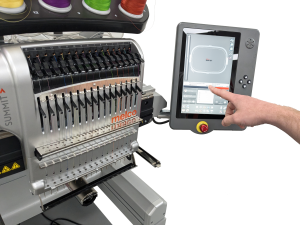
The new embroidery system solutions recently launched on the market have additional functionality using variable data and scanning functions (barcode or QR code) to make the embroidery of individual names automated which reduces production errors to almost zero, making the process idiot proof and more efficient. Other features include automatic thread sequencing and the ability to bring a design that your customer has created on the Shopify site for example straight into the machine as an embroidery file ready to embroidery.
Aside of the above carefully consider the supplier of your machine, check out their training, support, warranty, and on-going maintenance costs, and look carefully into the sourcing of your consumables, threads, backing etc. as the machine is only one part of getting quality embroidery every time.