 Printwear & Promotion The Total Promotional Package
It’s no secret direct to film printing can be time consuming and labour intensive. Colin Marsh, managing director at Resolute, speaks on why you should be streamlining your DTF process and the ways in which this can be achieved.
Since the inception of direct to film, just a few years back, developments in refining the DTF process have been a key factor to its success.
With expectations growing in all areas of use, the DTF process is developing at a remarkable rate. As fast as DTF is, there is always room for improvement. Streamlining an existing process is common practice, and none more than DTF heat seal transfers.
The number of DTF transfers produced in the UK is already millions per month. With the majority of garments being decorated in this way, the smart move is to streamline the current DTF process and increase production.
Automation is the buzz word here, and there are plenty of solutions available with many more in the pipeline.
Introducing a tab cut
When DTF transfers are printed, they need to be cut out ready for pressing or shipping. Cutting is the most labour-intensive part of producing a DTF transfer; we have all seen the range of flatbed cutters that are now available designed specifically for textile DTF and UV DTF.
If you have used one of these cutters you will know it can still be quite labour intensive picking the transfers off the vacuum belt or out of the catch tray. Transporting transfers post cutting can be made simple with the introduction of a tab cut.
This type of cut leaves each transfer attached to the main sheet by a few tiny un-cut tabs. These are generally 0.5mm which is just enough to hold the transfer in place on the sheet while making it quick and simple to pop out when it is time to press them.
Using automated robotics

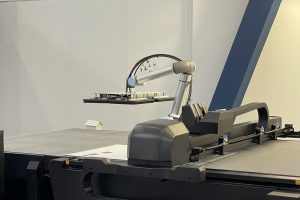
Going one step further is the introduction of automated robotics. We are not talking humanoid walking robots here, just a simple static device called a Cobot.
I witnessed Cobots in use for the first time two years ago, you guessed it, in China! In the early days programming was a complex process that made the Cobot slow to set up and many companies dismissed them. Two years on we are now seeing Cobots that can be programmed by the actions of a human operator, by simply performing the task once is enough for the Cobot to learn and take over.
Equipped with suction cups in a hand shape, Cobots can quickly pick cut transfers off the vacuum belt and stack them neatly ready for pressing or packing. Once they start working 24/7 on repetitive tasks, a Cobot becomes a valuable asset for streamlining production.
Where can you get a Cobot? If you want to buy one in the UK you are going to have to spend a lot of money or wait a while for prices to drop in the manufacture of the mechanics. The learning software is available but improvements are still in development. Several new models were launched at the SGI Dubai International Printing Exhibition in September, where, due to popularity, a separate section was dedicated to AI and robotics in the print industry.
Considering consumables
Consumables are also contributing to streamlining the DTF process, with advancements in film coatings reducing heat press times.
Just two years ago, it was common for DTF to require 20 seconds and waiting for a cold peel, but recently released films now offer press times of just three seconds at 130°C, followed by an instant hot peel. In most cases, a three-second heat press with an instant hot peel, followed by a three-second post-peel press, is much faster than the initial press using older film technology. These advancements in film coatings have not only enhanced vibrancy but also eliminated the issue of colours appearing slightly dulled with hot peel films compared to cold peel films. The new films now provide the same vibrancy while reducing press times and operating at lower temperatures, which enhances the quality of prints on polyester garments. Additionally, it is now possible to press onto sublimated sports shirts with improvements in the printing process.
For optimal results, a specially formulated white ink can be utilised, along with necessary modifications to the DTF printer and operating software. While this may sound complex, the combination of various minor improvements has resulted in a process that is now 99% successful. This new method has also enhanced performance on rain jackets and softshell garments.