 Printwear & Promotion The Total Promotional Package
 From rising e-commerce brands to bespoke uniforms for UK hospitality, garment decoration is no longer a side hustle – it’s a serious industry. But as the UK market evolves, so must the methods we use to decorate garments. In a space increasingly driven by customisation, sustainability, and speed, choosing the right embellishment technique isn’t just a technical decision – it’s a strategic one.
Shabbir Maimoon, director at Snuggle, reports.
Whether you’re serving fashion-forward Gen Z consumers or equipping a corporate client, understanding which method fits which market can be the difference between profit and friction.
Understanding the UK Landscape
Recent estimates place the UK garment decoration market at around $245 million printing revenue (Grandview Research), with clear momentum behind customised digital printing over non-customised apparel. A few insights stand out:
- Cotton leads the way, making up 61% of decorated garments, followed by polyester (16%) and blends (8%).
- Decoration demand is shaped heavily by branding, entertainment, and advertising.
- Design styles are roughly split: 60% favour graphic-based prints, while 40% lean toward artwork and illustration – a sign of both commercial and creative needs.
- New technologies like DTF are disrupting the status quo, showing high compound annual growth across supplies, equipment, ink, and print volume.
Sources: Grandview Research, Credence Research, and KeyPoint Intelligence.
Matching method to market
Let’s explore how each major technique aligns with key UK segments:
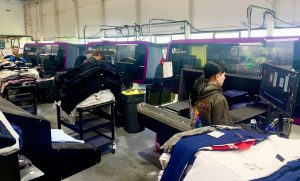 DTG (direct to garment)
- Best for: Cotton or blends on standard placement positioning, a wide spectrum of industry from retail fashion apparel, music merch and promotional marketing.
- Why it works: Low setup costs, photorealistic prints, and easy integration with e-commerce platforms like Shopify, Woo Commerce, Canva.
- UK fit: Ideal for artists and designers leveraging local POD (print on-demand) services or short run with fast turnaround. Test and repeat.
- Caution: Less of a fit for high-volume, one or two colour designs and polyester-heavy garments.
DTF (direct to film)
- Best for: Odd placement decoration or smaller graphics on standard placement positions. Workwear, Performance wear, streetwear items across apparel, headwear, bags.
- Why it works: Adheres to a wide range of fabrics, handles stretch, and delivers vibrant results.
- UK fit: With the UK’s diverse clothing market – from yoga brands to festival gear – DTF offers versatility at scale.
- Caution: Still maturing, with quality varying by provider.
Screen printing
- Best for: Bulk orders with simple designs – merch, promos, uniforms.
- Why it works: Economical at volume, especially on cotton.
- UK fit: Events and music merch – all still lean on screen printing for cost-effective volume branding.
- Caution: High setup and labour costs make it inefficient for small orders or multi-colour artwork.
Embroidery
- Best for: Premium apparel, uniforms, and brand-building.
- Why it works: Durable, textured, and commands higher perceived value.
- UK fit: Hospitality, retail, and luxury streetwear brands use embroidery to elevate their visual identity.
- Caution: Less suited to fine detail; higher per-unit cost.

Sustainability and hybridisation – Key UK trends
UK consumers care deeply about ethical production, environmental impact, and quality over quantity. Here’s how decoration trends reflect that:
- DTG and DTF support on-demand models, reducing waste and unsold stock.
- Embroidery aligns with premium positioning and longevity – a win for the slow fashion movement.
- Local fulfilment is on the rise – not just for speed, but for carbon-conscious branding and de-risking inventory management.
- Hybrid operations (offering multiple techniques under one roof) are increasingly common among UK decorators responding to diverse client demands.
Conclusion: The smart match wins
The UK garment decoration market, valued at $245M of printing revenue alone, is a space of massive opportunity with a (CAGR of 13% 2020- 2027) – but only for those who get their method-to-market match right.
In an age where speed matters, but so does sustainability and brand storytelling, the technique you choose is a reflection of your values as much as your capabilities. Whether you’re customers need printing for workwear, promotions, fashion, fitness or festivals, the future belongs to decorators who think beyond the machine – and focus on the fit.
Choose the right method, for the right product, in the right moment – and your clients won’t just wear it. They’ll remember it.