 Printwear & Promotion The Total Promotional Package

With so many walks of life, almost everyone wants to feel included, and that usually comes with the clothes they wear. Acting editor Benjamin Austin speaks with Lonely Kids Club owner Warwick Levy about how he has tried to build a brand that helps people feel part of something bigger.
A T shirt, throughout its history, has been a piece of clothing that revels in self-expression.
From political slogans and quirky catchphrases to simple logos or illustrations, it is a piece of clothing that allows for such imagery in its simplicity – no wonder the New York Times once coined it ‘the medium for a message’.
Printed clothing can allow for personalities to thrive and advertise themselves to the world and find a way to connect to others in a way that regular messages couldn’t – after all, a picture paints a thousand words.
By doing so, people can find a community where they feel included and perhaps not so alone in a world that is seemingly creating more and more divides.
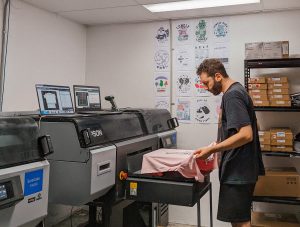
Enter the Lonely Kids Club. A small garment printing enterprise working out of Artarmon, Sydney, it has been providing decorated unisex fashion that it hopes helps people connect with the message and artwork represented on their chests.
Founded in 2011 by owner Warwick Levy, the enterprise has grown from a shed in an artist’s garden, selling finished products at morning markets and outside gigs, to a fully-fledged studio corporation.
 It starts with one
Warwick was in Europe when the idea of Lonely Kids Club started forming.
He said: “I was studying construction at UNSW and was pretty miserable doing it. I left the degree and went to Europe for a while. By the time I came back, the idea of starting a gender-neutral clothing label was much more settled. That was the direction I wanted to take.
“I really like T shirts and wanted to make them. Clothes had helped me feel more like myself and connect with people.
“Wearing something a bit weird could start a conversation without me having to be particularly good at starting one.
“I wanted to make clothes that did that for other people too. Eventually I decided I should actually give it a go rather than stay in a degree I didn’t want to be doing.”
Though the idea may have been bubbling away, the name was something that seemingly took less consideration, but it is a name that stands out and one that does portray the company’s ethic very nicely.
Warwick continued: “It started as a joke between me and my friend. We were both single while our friends were all in relationships, so we joked about having our own Lonely Kids Club. We even had a pact to get married if we were both still single at 45.
“Around the same time, I decided to leave my construction degree and start making clothes, and the name stuck.
“For me, it also meant putting creativity and happiness ahead of what other people thought you were supposed to do. You can like something a bit strange, wear what feels right to you and find other people who get it.”
It’s never easy finding your feet when starting a new business, and it did take Warwick a lot of sacrifices to make the dream come true.
He said: “It was self-funded and started very small. In the early years, I did freelance e-commerce and design work to keep myself going while I tried to build the label.
“It definitely didn’t arrive as a fully formed, successful business. The first couple of years were rough.”
 The message is heard
It wasn’t until 2013 that Lonely Kids Club got its big break.
Warwick continued: “A customer posted the Cecil sloth jumper in a Facebook group, and it went viral. That was the first proper breakthrough after a couple of years, and it was the first time this might actually work.
“It getting shared helped enormously. It taught me that you don’t always know which idea will connect with people.”
But it was a break that was much welcomed and has helped lead Lonely Kids Club to become an enterprise employing four members of staff, as well as supporting independent artists.
Warwick said: “Artwork is a big part of what we do. We make designs ourselves and work with independent illustrators, including Bridget Farmer, Kayla Reay and Claire Harrison. They keep the rights to their work and receive commission from sales.
“A lot of it starts with finding drawings I love and reaching out to see if we can work together. That’s how the first collection happened: I found an artist in Melbourne and spent a week staying in his shed while we made the designs.
“That personal connection with the artwork is still a big part of it. We work with a mix of our own team and independent artists, with the artists keeping ownership of their work.”
During the 15 years in business, Lonely Kids Club has faced its fair share of challenges.
Warwick continued: “We’ve had ideas that completely failed. We made a range called Velcro World, where you could move patches between shirts and hats. We had the Velcro sewn onto everything by hand, and I thought it was a great idea.
“It tanked. We lost money clearing it out, but continuing to push it would have been worse. Learning when to let something go has been important.
“Most recently, we’ve also had our artwork and product photos copied onto Temu. That’s difficult when the designs belong to real artists who should be getting paid for their work.
“I spent a lot of time reporting listings and using our registered brand name in the complaints helped get them removed.”
 Join the club
Despite the challenges, Lonely Kids Club sticks to its ethos of inclusivity, and it is and will always be a large part of what Warwick aims to do.
“I don’t see why a shirt with a pigeon should have a gender,” Warwick said. “That should carry through to how people are treated; whether they’re buying a shirt, working with us as an artist or coming into the studio. I don’t want someone to feel they have to explain or justify who they are.
“Mental health has always been personal to me too, which is why it shows up so much in the brand.
“We run the Lonely Kids Club Facebook Group called lonely kids club club, where people can share selfies, talk and feel welcome.”
I suppose therefore that is the message Warwick’s medium has and will always try to envisage. Giving a safe space and brand for people to express themselves is what keeps pushing Warwick to run Lonely Kids Club the way he does.
He concluded: “After 15 years, I still want to be making things we enjoy and doing it in a way I can feel good about it.”
In this world of constant surveillance and endless forums, which push more and more people to feel isolated, it is easier to feel lonelier than ever. But if you do, don’t worry, there is a club just for you.