 Printwear & Promotion The Total Promotional Package
Fashion has often overlooked the advancement of technology within its sector, opting for more archaic processes to achieve its beauty and design. But one range at this year’s Fashion Week in Barcelona embraced the use of digital printing, and its creator has sung its praises. Acting editor Benjmain Austin explains.
Fashion has always been a reflection of the times. From hemlines that challenged convention to slogans that captured the spirit of a generation, clothing has long served as a vehicle for self-expression and social commentary. Increasingly, however, the way those stories are brought to life is changing.
Digital print technology is transforming the relationship between concept and creation, allowing designers to work with fewer creative constraints while maintaining the colour accuracy, detail and consistency demanded by modern fashion.
For emerging labels and established brands alike, print is no longer simply a method of decoration. It is becoming a part of the design language.
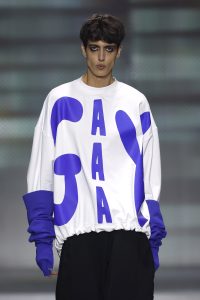
Few recent collections demonstrate this shift more powerfully than AAA Studio’s Señora, suélteme el brazo, unveiled at 080 Barcelona Fashion Week.
Created by founder Arnau Climent, the collection set out to make an unapologetic statement.
The title, which translates to “Ma’am, let go of my arm”, reflects a pivotal moment of resistance: The point at which a younger generation stops explaining itself and refuses to conform to rules and expectations it had no part in creating.
The message ran throughout the collection, not just through silhouettes and styling, but through the garments’ printed elements themselves.
Arnau said: “At the end of the day, prints are everything in the collection because they work as a very clear statement.
“I wanted the messages to feel direct and unapologetic.”
Print as the message

Bold typography, raw imagery and emotionally charged visual references formed the backbone of the collection. Rather than supporting the narrative, the printed graphics carried it.
Achieving that vision required a production approach capable of faithfully reproducing intricate detail, subtle tonal variation and precise colour consistency.
AAA Studio had previously explored methods including screen printing and dye sublimation. While both techniques offered advantages, neither fully aligned with the demands of this project.
Screen printing remains prized for durability and impact, particularly for larger production runs. However, highly detailed artwork, extensive colour variations and photographic elements can introduce additional complexity, time and cost.
Dye sublimation provides vibrant results on suitable polyester substrates but can limit material choice and application.
For a collection built around direct visual storytelling, compromise was not an option.
Translating vision into reality
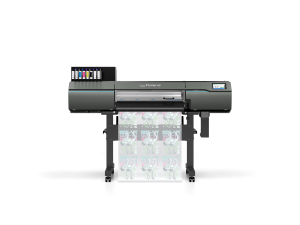
AAA Studio decided on using the Roland DG TY-300i direct to film (DTF) printer to prototype and produce garment graphics for the runway collection.
The TY-300i has been developed specifically for production-ready DTF workflows, delivering detailed image reproduction, colour consistency and dependable output across apparel applications.
Its capabilities proved particularly suited to the expressive nature of the project.
“We needed exact colour precision,” Arnau said. “Colour carries a lot of weight within the collection, so the ability to access consistent colour was one of the most useful aspects of printing with the TY-300i.”
The ability to reproduce vivid colours, smooth gradients and intricate details allowed the studio to maintain the integrity of the original artwork throughout production.
For designers working with emotionally driven concepts, this level of consistency can prove crucial.
Subtle shifts in tone, slight changes in contrast or inconsistencies between garments have the potential to alter the intended impact of a piece. Reliable digital output helps preserve the original creative intent from screen to finished garment.
A process of experimentation
Like many creative projects, the journey from concept to catwalk was not without its learning curve.
For Arnau, working with DTF technology became both a production exercise and an educational experience.
He said: “It was a learning experience, especially throughout the testing process to get to the final result.
“I didn’t have much previous experience with this type of machinery, so working with Roland DG also helped me better understand how the machinery works and how to take advantage of it.”
Testing different approaches allowed the team to refine how artwork translated onto fabric and how graphics interacted with garment construction.
Rather than forcing changes to the original concept, the process informed how those ideas could be most effectively realised.
Arnau explained: “More than changing the concept itself, it helped adjust how to bring the designs onto the garment,”
For decorators and fashion brands alike, this highlights one of digital print’s greatest strengths: the opportunity to experiment, refine and perfect without the extensive setup requirements traditionally associated with garment decoration.
Freedom to create
Perhaps the most significant benefit was the creative freedom digital print introduced into the design process.
Historically, production considerations often shaped ideas from the outset. Designers might simplify graphics, reduce colour palettes or rethink applications based on technical limitations. Digital technologies are changing that.
Arnau said: “It allowed me not to limit my ideas so much from the start.
“I could work with more raw imagery and more direct typography without thinking about technical limitations immediately.”
That freedom helped narrow the gap between imagination and execution.
“It’s helpful in bringing the initial idea closer to the final result. There’s potential for a much more direct flow between concept and production.”
For today’s fashion industry, where authenticity and individuality are increasingly valued, that directness carries significant appeal.
Consumers are seeking products that feel personal and meaningful. Designers, meanwhile, are searching for ways to communicate their identities without compromise. Digital print offers a pathway to both.
A new age for fashion
As fashion continues to evolve, smaller production runs, faster development cycles and highly individual visual identities are becoming increasingly common.
Digital garment decoration is well positioned to support these changing demands.
Arnau concluded: “I’m very interested in continuing to explore it as a tool, especially for direct graphics, clear messages, and smaller or more specific productions.”
Alongside creative flexibility, digital workflows can also support more efficient production practices. By reducing lengthy setup processes and minimising unnecessary testing, designers have greater opportunity to limit waste and avoid excess material consumption.
The TY-300i further supports this through robust engineering and automated, guided maintenance features designed to maintain consistent day-to-day performance.
For the promotional clothing and garment decoration sectors, the implications extend beyond high fashion.
The same technologies enabling runway designers to push creative boundaries can empower decorators to offer more personalised products, tackle increasingly complex artwork and respond more effectively to changing customer expectations.
AAA Studio’s latest collection serves as a reminder that print is no longer simply a means of putting graphics onto fabric.
In the hands of today’s designers, it has become an essential creative tool.
As fashion embraces more expressive, agile and individual forms of production, digital print is helping bridge the gap between idea and execution.
For collections built around identity, emotion and statement-making visuals, the technology is not just supporting creativity, it is becoming part of the story itself.