 Printwear & Promotion The Total Promotional Package
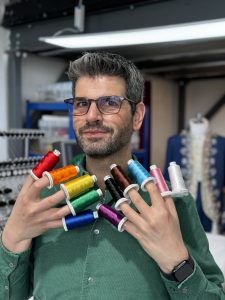
Since graduating from University of the Arts London nearly a decade ago, Twan Lentjes has worked in everything from theatre to film. Having completed work for Royal Opera House, Netflix, Walt Disney Studios, and Universal Pictures, P&P assistant editor Cameron Beech spoke with Twan to find out more.
Upon returning to university to study costume interpretation in 2016 at the Wimbledon College of Arts, Dutch digital embroiderer and costume maker, Twan Lentjes, has made magnificent waves in the film and theatre industries with his spell-bindingly ornate embroidery.
With a portfolio boasting the likes of Disney’s The Little Mermaid, Universal Pictures’ Wicked, and Netflix’s Queen Charlotte, Twan’s journey in crafting transcendental works of embroidered art has become a series of consecutive success stories. But what was the first success story?
The seminal habit à la Française
Twan’s time at university acted as a key pillar in his career, undertaking various projects which would set him upon a very fortunate path. However, it was his recreation of the Habit à la Française, which proved to be his most seminal work. The garment had been recreated for a project on Real Lives, with students being tasked with creating something based off a real-life garment or person. When asked why the Habit had stood out, Twan explained: “Just before starting university, I had gone to the V&A, where they had opened a new section. There was a suit there called the Habit à la Française, which is a fully embroidered trench suit in the French style and I was wowed.
“Ever since, that stuck with me and when it came to third year, where we had to decide what to do our final project on, I knew I needed to make something like that, that is my dream.” It was a dream which led Twan down a life-changing rabbit hole, where he would come across a certain Habit for an Otto Baron van Randwijck.
Twan explained: “I was researching 18th century wear for third year, and at one point, I came upon a picture in The Kunstmuseum Den Haag in The Netherlands. I emailed the museum because I could not find a high-resolution image, but it said it was worn by a Dutch person, so I thought why shouldn’t I remake that one? It makes it more interesting; its closer to home.
“It turned out this person was the stablemaster of Willem V, and Otto Baron van Randwijck. Otto became the mayor of the town where I was born. I thought that was quite crazy, so that’s why that was another reason for me to specifically choose this blue suit to recreate.”

Wilcom and MGC Futures
Another reason for the Habit’s influence on Twan’s career was because of its leading to Twan’s integral relationship with embroidery software, Wilcom. Twan admitted: “We didn’t have embroidery facilities at my university, I could embroider by hand, but that would take me years.
“Between my third and final year, I researched and found digital embroidery to be a thing. I trialled the software for 30 days to try it out.
“I emailed Wilcom, because they have an educational page, and they were really kind to offer me the chance to use their software for three months, until I had completed all of my embroidery.”
Twan continued to explain: “Christopher Oram, who is a costume and set designer I followed on Instagram, told me to apply for the bursary, which is from his husband’s company, Michael Grandage Futures (MGC Futures). You can apply for a bursary in different fields for theatre, and this was the first year they did the bursary for Stephanie Arditti. She sadly passed away from cancer the year before; she was a huge supervisor within the theatre industry. I applied to that thinking it’s not really for students, but then I got the bursary to buy the actual software. That’s why, after university, I was able to still offer embroidery services even though I didn’t have a machine.”
With the funding MGC Futures provided, Twan’s scope for opportunity was forever changed, and with the connections fostered throughout his time at university, he earned work on one very special production.
Part of a new world
After initially being hired on The Little Mermaid as a costume maker in Alessio O’Driscoll’s team, the tides slowly began to turn once Twan’s embroidery skills floated to the surface, working on embroidering the wedding dress for arguably Disney’s most famous mermaid, Ariel. Propelling the job to another plain of romanticism was Twan’s recollection of The Little Mermaid being the first film he remembered seeing in the cinemas, as well as Ariel being his first Barbie doll. Twan said: “There’s such a history behind why I really wanted to work on The Little Mermaid. Working on Ariel’s costumes, designed by Colleen Atwood, for me was like a dream come true.”

Twan spoke of one of his favourite moments from the project: watching the final shot of the film as Halle Bailey walked towards the sunset, wearing his very own embroidery. Twan said: “Out in Sardinia, I got to go out and watch when they were shooting the final shot of the film when Triton pushes away the boat.
“We were standing quite close to where the action was happening and there was a speaker right next to us blasting the last notes of the music, and the very first shot of seeing Halle Bailey in the dress I embroidered in the sun made me tear up. It was such a magical moment to hear those final beats of the music, and then seeing that happen right in front of you.”
The Little Mermaid had an amazingly circular effect on Twan’s life, from owning an Ariel Barbie doll in childhood, to embroidering Ariel’s iconic wedding dress for the live action remake. Twan had spoken of the impact owning the Ariel doll had in his early childhood, saying: “Because of having that Barbie doll, I took it to school, and that’s why I started to get bullied. I loved having these dolls, but at the same time, having that Ariel doll at the beginning when I was so young really made my life difficult as a child at school.” After hearing his childhood experiences, I asked Twan if his younger self would have believed the success his older self would come to discover. Twan answered: “I don’t know if my younger self would have believed it, that this could happen, or even that I could be happy as myself.”
It was inspirational to listen to Twan speak on the many pieces he had a hand in embroidering for the Walt Disney Studios remake. Twan explained: “I did some embroidery for Vanessa’s shoes, which are the tentacles, because they still wanted to have a reflection of her. I also did some of the embroidery for Rosa [a maid who works in Prince Eric’s castle]. They had this original 1970s bedspread with hand embroidery, so they then asked me to replicate some of it because they had to have a second dress and there wasn’t enough of the embroidery.”
However, the work for Twan didn’t just end there. Not only had Twan worked on the costumes for Disney’s live action Ariel, Halle Bailey, but he also worked on a blouse for the voice of the original 1989 Ariel, Jodi Benson. There is something aptly poetic about the past and present Disney princesses meeting in the work of Twan. Little did Twan know that his work on The Little Mermaid would lead him to earn work on another iconic wedding dress; this time, for Netflix’s Queen Charlotte.
A dress fit for a Queen… Charlotte
The story of Twan working on Queen Charlotte all began in Sardinia, while on the set of The Little Mermaid, where he would meet Marco Alzari. Marco, the Italian supervisor for The Little Mermaid’s costume team, would later be the man to recommend Twan to Laura Frecon, the co-designer for Queen Charlotte, after he was amazed by execution of Twan’s embroidered work.
With respect to creative liberty, Queen Charlotte has a fascinating relationship with history, being set in a fictionalised historical time period. Twan mentioned: “Especially with something like Queen Charlotte, even though it is set within a historical time, it is a fantasy world, so you can do whatever you want.
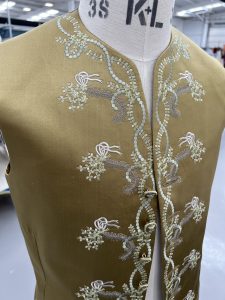
“I did two dresses for one of the princesses; there was a double wedding in the regency time. There is this nice book with original embroidery drawings; it’s in black and white and follows shapes that were used at the time. I looked at pictures from that and thought, ooh, this design might work well with the dress. Because of time restraints, I only used one colour of thread; it ran in one whole frame and was one thread cut so it would be quick, but because of all the different directions as well of the lights, you would get so much variation in the colour.”
I asked Twan what pieces of his would viewers of the show be able to spot, not expecting Twan to name two of the most iconic costumes from the show: Queen Charlotte’s wedding dress and King George’s coronation suit; both spectacular feats with respect to art and design. However, Twan surprisingly expressed his astonishment at seeing his embroidered work on Queen Charlotte’s iconic wedding dress plastered across the media and across major cities. He explained: “Designer Lyn Paolo[of the dress] posted a picture on their Instagram from Los Angeles, and it was 15 stories high on a building.
“It also popped up on a billboard I drove past. It was surreal. It was also on the front of the Radio Times. It was a weird feeling to see your work printed everywhere.”
Speaking of witnessing your artwork in all forms of media worldwide, Twan began to speak on his work for Universal Pictures’ Wicked, set for release this month.
Wickedly defying embroidery
In the same discussion on creative liberty, Twan said: “On Wicked, we had fully realised designs costume designer Paul Tazewell, but there was a freedom in like yes, we had to create those shapes and what you see, but how we do that was our freedom.”
As a long-time fan of Wicked, it was fantastic to listen to Twan’s enthusiasm, especially when he began speaking of the work which went into Fiyero’s waistcoat. Twan began by saying: “It was so much work but we had a lot of freedom. Fiyero turns into the scarecrow, so on the design, he already had wheat stems on his sleeve, which Hattie McGill hand embroidered on his sleeves. But for the waistcoat, there were so many shapes, so I thought how can I incorporate more wheat stems into that?
“What I did was a tatami fill in wool thread and wheat stems in a satin classic Madeira thread on top of it, so you got two different textures and the shininess of the wheat really shows through. If you look close enough, you can see it’s all over his waistcoat, like a hint towards his future. I had help from Jessie Dickinson with the digitising and it was also hand embroidered into by her and Beth Parry.”
An attention to Wicked’s detailing, however, was not new to Twan. Between his second and third year of university, Twan approached Naomi Isaacs, an associate lecturer at UAL, enquiring after work experience with her, due to her work with West End leading ladies, including working on Glinda’s bubble gown. In his recollection of this time, one anecdote in particular stood out among the rest.
Twan said: “There was a fitting Naomi took me to, and the actress was not there yet, but they were preparing for the tour at the time. It was in an abandoned church and the whole room was full of Wicked costumes.
“It was amazing to be able to get to see all these garments up close because they’re so intricate and detailed.
“Half of the time, you don’t know it needs that much detail to make it look alive.”
Masters of the insignia
On the subject of bringing things to life, tasked with embroidering over 1,900 insignias in 14 different designs, Twan had his work cut out for him for Apple TV’s Master of the Air, which follows the Eighth Air Force of the United States during the Second World War. In comparison to Twan’s fantastical work for the musical productions of The Little Mermaid, and Wicked, this project on the historical events of World War II, sounds as though it is worlds apart from Twan’s usual portfolio, and I asked if his approached differed at all, due to a drastically different subject matter.
Twan answered: “In a sense it was a completely different approach because it had to be really precise. The detail was small, because they were only 8x3cm maximum. That was a nice challenge for me.
“Because it was based on true history, I wanted to replicate them as close as possible.”

However, Twan’s interaction with history didn’t just stop at his replication of the Air Force insignias. Production took its engagement with the history to another dimension when Twan was tasked with embroidering onto authentic WWII fabrics. Embroidering fabrics to upkeep the highest level of authenticity is challenge enough, but add using authentic fabrics into the mix and you take the challenge to another plain. As Twan said: “When you’re copying something exactly, you want it to look as authentic as possible. Maybe if I didn’t try as hard as I did, it probably would have still been fine, but for me, it needed to look exactly like the original.”
Though there was not one unified subject matter in Twan’s portfolio, there was a common thread which tied each project together, which was sentimentality. A childhood familiarity with Ariel, an interest in courtly costume brought upon by an interest fostered at university, a historical tie to WWII with Twan’s old place of residence in the Netherlands being close to the German border. It is clear Twan’s work is sewn together by a passion for the sentimental and emotional, and it will be interesting to see where his next project will lead him.