 Printwear & Promotion The Total Promotional Package

DTF has progressed so far in the last few years; it is no wonder companies look to see if the limits on the technology can be pushed. In this column, Colin Marsh, managing director of Resolute, explains even newer trends coming from the technology.
Direct to film (DTF) printing has rapidly established itself as a transformative technology within the textile and garment decoration industry. Traditionally, roll to roll (R2R) systems have dominated DTF systems, offering high-volume production and continuous operation.
However, as industry demands evolve and the need for smarter, more integrated workflows becomes apparent, a new trend is emerging, the transition from roll to roll to roll to sheet (R2S) systems. This shift, championed by market leaders Resolute, in partnership with Gildan, promises to elevate efficiency, speed, and automation throughout the DTF workflow. With the concept of automated R2S starting back in January 2024, let’s take a look at where R2S is today.
The limitations of roll to roll DTF printing
Roll to roll printing has been the backbone of DTF for its ability to process large volumes of film efficiently. Yet, this approach has some challenges over R2S systems. The continuous nature of R2R means that each stage, printing, curing, cutting, and handling, must be synchronised. Any delay, misalignment, or error can disrupt the entire process, wasting time or even worse, leading to reprints.
The emergence of roll to sheet systems
Roll to sheet systems address many of the challenges associated with traditional R2R setups. In an R2S workflow, the printed film is automatically cut into individual sheets immediately after printing and before curing or powder application. These sheets are then processed independently, allowing for greater flexibility and precision at every stage. This automated modular approach not only streamlines the workflow but also enables the integration of advanced automation technologies, such as AI-driven quality control and tracking systems.
Key advantages of R2S
One of the primary drivers behind the shift to roll-to-sheet systems is improved efficiency. By decoupling the print and curing process, R2S allows for parallel operations, while one sheet is being cured, another can be printed, and yet another can be prepared for pressing, all automatically with no operator intervention. When you look at the flexibility of sheets over a roll, the flexibility soon becomes clear. This multi-threaded workflow significantly boosts throughput and minimises bottlenecks.
Speed is further enhanced by the elimination of manual collation. Automated sheet handling reduces the risk of human error, accelerates job changeovers, and enables rapid adaptation to varying order sizes and designs. For high-mix, low-volume production (one-off web orders), an increasingly common scenario in the era of customisation, these attributes are invaluable.
Optimising the curing process
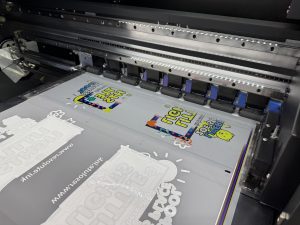
Curing is a critical step in DTF printing, as it ensures the durability and wash fastness of the printed image. In roll to roll systems, maintaining consistent curing across the entire length of the roll can be challenging; speed and environmental conditions play a big part in this process. With roll to sheet, each sheet can be cured under optimised and uniform conditions, offering consistent quality and reducing the likelihood of variation. More economical roll sizes can be run to eliminate waste. The most common heat press size, being 40cm x 50cm, does not require any more than a roll width of 60cm; this includes multiple QR codes, quality check colour bars, printed in the out-of-image areas attached by a perforated tear-off.
Moreover, the nature of sheets allows for the implementation of smart curing tunnels that automatically adjust parameters based on the sheet’s characteristics, such as ink type, adhesive powder type and film type, further enhancing the reliability and efficiency of the process.
Templated roll to sheets and the power of QR codes
These new innovative systems take the R2S concept a step further by introducing templated sheets that can embed QR codes. Each code uniquely identifies the sheet and can be scanned at various stages of production. This capability unlocks a host of benefits and is applied by the relevant queue in the RIP:
- Automated Process Activation: As a sheet moves through the workflow, scanning its QR code can trigger specific actions, such as adjusting curing parameters, initiating picking of the garment ready for pressing and updating inventory records, helping to avoid unexpected shortages.
- Traceability and Quality Control: QR codes enable real-time tracking of each print job, facilitating root cause analysis in the event of defects and ensuring compliance with brand standards is met.
- Integration with AI: By linking QR codes to a central AI-driven management system, data collected at each stage can initiate predictive maintenance, optimise your resource allocation, and drive continuous improvement.
The future of DTF workflows
Perhaps the most transformative aspect of a R2S system is the integration of artificial intelligence at the point of shipping. Once a product reaches the shipping department, its QR code activates an AI system that automatically verifies order details, selects the optimal packing configuration, and updates the logistics platforms for collection. This level of automation reduces labour costs, shortens lead times, and minimises errors, ensuring an almost seamless experience for both garment decorators and their customers.
Global impact and industry adoption
Currently, Resolute is almost two years into the development of roll to sheet DTF systems. This has already attracted interest from major brands across the globe, who recognise the potential of R2S to revolutionise DTF transfer production and textile printing. By 2026, more companies will have started to develop fully automated R2S systems, meaning the days of traditional high production roll-to-roll DTF printing may soon be numbered.


