 Printwear & Promotion The Total Promotional Package
Three years ago, DTF prints that were previously considered to be impressive sometimes no longer meet our expectations! As the DTF process matures, higher standards are anticipated from this technology. This column by Colin Marsh, MD of Resolute, explains the differences between five-colour and nine-colour DTF printing, and why it is becoming the preferred DTF process at a rapid rate.
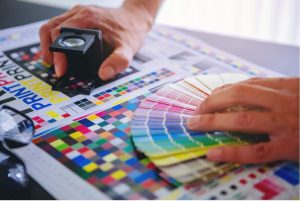
Using spot colours in digital printing is not new, but using them correctly requires a complex setup and a precise ICC profile to ensure colour accuracy and consistency.
An ICC profile characterises a colour device or colour space according to ICC standards. Because every brand of DTF ink uses slightly different bases for cyan, magenta, yellow, black, and spot colours, ICC profiles bring these variables back to an industry standard to produce consistent, predictable results.
ICC profile explained
Creating an ICC profile for a CMYKRGBO DTF system – which adds spot red, green, blue, and orange – is particularly challenging. Entry-level spectrometers such as the NIX or i1 Studio cannot generate such complex profiles.
High-end spectrometers with robotic arms are preferred because they can accurately scan the thousands of colour patches required.
The benefits, however, are significant. Comparing standard CMYK prints with output from a CMYKRGBO device shows dramatically improved vibrancy and colour range. In March 2025, Resolute’s R&D centre helped a major American ink manufacturer prepare the launch of their new spot colours for FESPA Berlin 2025. This led to the development of a new version of the R-Jet PRO DTF V4, nicknamed the HG (High Gamut), designed specifically for expanded-gamut printing.
Best use of spot colours
Spot colours can be used in two main ways. The first is manual allocation, where a vector or layered TIFF file assigns a specific spot colour to parts of the artwork. If the file’s spot colour name matches the RIP’s spot definition, that section will print with the selected spot ink. This method is precise but time-consuming and restricted to certain file formats.
The second method is automated blending, where a custom ICC profile uses all eight colour channels to enhance imported artwork without altering the original file. This approach boosts vibrancy and accuracy across the entire image. Both methods can be combined, such as when a company logo must reproduce an exact Pantone shade while the rest of the image uses blended colour.
Digital spot-colour mixing works differently from litho printing: only eight base colours are available rather than litho’s eighteen.
Tools like Pantone Connect help bridge this gap by providing CIE LAB values, which describe all colours visible to the human eye. LAB values ensure precise colour matching across devices and media. Designers can scan a Pantone swatch with devices like the NIX Spectro to obtain LAB values and enter them directly into artwork or RIP software. It’s essential to scan from the correct Pantone book, as each printing process uses its own set of references.
LAB colour space overview:
- L (Lightness): 0 = black, 100 = white
- A: green (–) to magenta (+)
- B: blue (–) to yellow (+)
Media considerations
A blended spot-colour ICC profile greatly improves colour accuracy, but ICC profiles are media-specific. A profile created for one DTF film or ink set may not translate accurately to another. Changing films, inks, or even ink batches can affect consistency. Using a reputable brand with dependable supply and technical support is crucial; in some cases, suppliers may provide updated ICC profiles to compensate for changes.
How nine-colour DTF printers differ
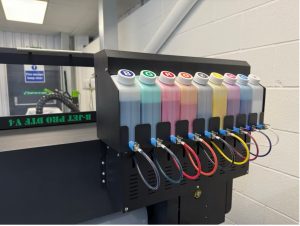 From the front, a nine-colour CMYKRGBO printer may look similar to a standard CMYK model. Internally, however, it uses additional ink channels for the extra colours and requires extra tanks at the rear of the machine. The white ink channels remain unchanged.
These printers offer real advantages, but only when the RIP software is properly configured. Without correct setup, the extra inks may be wasted with little visible improvement. Legacy CMYK jobs can still be printed using a separate CMYK profile, while new work can take advantage of the full expanded-gamut set. When upgrading, it’s important to plan for both workflows during the installation process.
Conclusion
Achieving colour accuracy in DTF printing requires experience, advanced equipment and an understanding of colour management. Even after 45 years in the industry, learning never stops. .