 Printwear & Promotion The Total Promotional Package
Most business investments are to replace ageing kit while others are maybe to help them dip their toes into a market otherwise unexplored. But it’s not very often that a major purchase completely shifts a company’s focus; but that is exactly what happened with Basic Thinking after making the big decision to bring in not one but two new Kornit Apollo’s. Acting editor Benjamin Austin speak with owner Kieran Hickey about the purchase and what it means for the business.
Apollo is a cultural pseudonym for innovation. The Greek god himself was an innovator in stories having been credited with inventing stringed instruments with his famous lute being the first, and his role in helping build the impenetrable wall of Troy has been recited for millenia.
The name emphasised this further in the 60s after the it was given to the NASA programme that worked to land the first man on the moon, and by 1969 the Apollo 11 achieved that with Neil Armstrong, a feat watched on by millions back on earth.
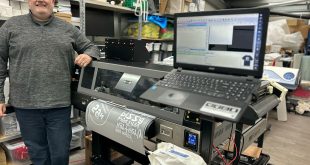
Now, Basic Thinking has called upon the name for its own innovation after installing a pair of new DTG printers from Kornit called the Apollo.
The Leicester-based printwear company has added not one but two of these printers as it looks to respond to a shift in the market, as retailers, brands, and online sellers increasingly demand flexibility, shorter runs, and faster turnaround times.
Historically known as a garment manufacturer serving high street retailers, the company is now positioning itself firmly within the on-demand production space as it looks to answer some of the new demands from the industry.
One small step
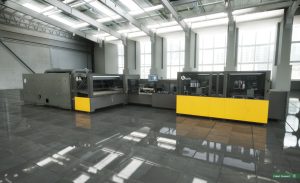
The Kornit Apollo is a relatively new addition to the direct to garment market and is designed to bridge the gap between traditional bulk screen printing and digital production.
Basic Thinking’s owner, Kieran Hickey, said: “The Apollo is a relatively new machine that has been out for just under two years.
“There are currently only three in the UK, and we own two of them – one was installed last July, and the second has been running for about two to three weeks.”
“It is a semi-automatic machine that can handle everything from single pieces to mass production at a rate of 400 pieces per hour.”
With two machines now installed, the company has effectively doubled its digital capacity, but more importantly, that speed allows Basic Thinking to serve both traditional retail orders and emerging on-demand opportunities.
Kieran continued: “With both machines, we have a capacity of 800 pieces per hour, or roughly 5,000 pieces per shift with just one operator per machine.
“Digital printing offers unlimited colours and quality, and this technology provides a screen-like finish.”
“The major advantage is the ability to print single pieces or mass quantities quickly, which allows us to provide ‘just in time’ stock for high street retailers or online platforms. We are transitioning from being a purely bulk business into the print on demand space.”
Mission beyond the shuttle

To support this shift, the company has invested beyond just printing hardware.
“In addition to the printers, we have automated folding and packing lines that handle bagging and barcode application,” Kieran explained. “We can also provide branding in the back necks of garments.”
The goal is to provide a fully integrated service that connects directly with online retail platforms.
“We want to plug into existing shops and organisations that need POD services.
Because Basic Thinking manufactures its own garments, Kieran says it can offer a pricing advantage over many POD providers.
“Because we manufacture our own t-shirts, we can combine lower garment costs with high-speed technology to offer a very competitive pricing model.”
The shift toward POD followed months of research and a change in mindset.
“Kornit is a partner in this, and we changed our mindset to move into this space about nine to 12 months ago because the Apollo machine offered a speed and bulk factor that nothing else could compete with.”
The first Apollo allowed the company to explore the potential of the technology. Installing a second system, however, reflects a longer-term commitment.
Kieran said: “We decided to get a second one for two reasons. Risk management, ensuring production never goes down, and to provide the extra capacity needed to grow the POD side of the business without it being hindered by our bulk orders.”
Working out all the kinks
For Kieran, the move toward on-demand production is also about tackling inefficiencies in the retail supply chain.
He continued: “Research showed we could satisfy our customer base by offering more flexibility. Instead of requiring minimum screen print runs, we can offer “stock on demand,” which reduces their risk and lets us enter a new market.
“It is a significant long-term investment, but we believe the future of the industry is moving toward on demand rather than traditional bulk buying. This model reduces waste, stock holdings, and markdowns.”
Forecasting demand in fashion is notoriously difficult, often resulting in either excess stock or missed opportunities. So, businesses looking to add to their retail offering would want to do so with as little financial risk as possible.
By enabling smaller, faster reorders, retailers can significantly reduce that risk.
Kieran said: “There is so much waste in the industry when people get their forecasting wrong,” Hickey says. “It is impossible to get it 100% right; you either undercook or overcook an order.”
“I call it trade on demand. For example, a retailer who might normally have to buy 500 pieces to meet screen printing minimums can now buy just 200. If the item sells well, they can quickly top up with 50 or 100 pieces.”
One giant leap
Another key differentiator for Basic Thinking is its vertically integrated model. Unlike many POD providers that rely on third-party garment wholesalers, the company controls its supply chain from production through to print.
Kieran said: “Most competitors buy off-the-shelf shirts from wholesalers like Ralawise. “Because we manufacture our own garments in Egypt, our starting cost is much lower.”
Combined with the speed of the Apollo systems, this provides a strong competitive edge.
“Our strap line is essentially ‘A to Z’ – there is no middleman. The Apollo prints 350 to 400 pieces an hour compared to 100 on other machines, so we have a huge cost advantage,”
By focusing on its core strengths, basic t-shirt ranges produced in different weights and styles, Basic Thinking believes it can deliver both efficiency and price competitiveness in the growing POD market.
‘Good luck Mr Gorsky’
With two Kornit Apollo machines now in operation, the Leicester company is positioning itself to serve a market increasingly driven by speed, flexibility, and demand-led production.
For Kieran, the direction of travel for the industry is clear: the future of printwear lies not in predicting demand months in advance, but in producing exactly what customers need, exactly when they need it.
So it would be cliché to suggest the Sun is rising on a new dawn for Basic Thinking but then again Apollo is known as the god of the Sun so perhaps it is rather fitting.