 Printwear & Promotion The Total Promotional Package
Fail to prepare, prepare to fail. It is a mantra that can be brought throughout life; screen printing included. Sometimes, any amount of hard work won’t stop a bad print if you haven’t laid the foundations first. Beppe Quaglia, CEO and president of Virus Inks, explains the five mistakes all screen printers make and offers ways to correct them.
In screen printing, the quality of the final print is determined long before the first squeegee stroke. Among all the pre-press stages, screen exposure plays the most decisive role.
Even experienced printers can fall into subtle traps that compromise stencil durability, image definition, and ultimately print consistency. Exposure is not just about ‘getting light onto the screen’ – it is a precise technical step, influenced by mesh geometry, emulsion thickness, lamp spectrum, and post-processing. Misjudging any of these factors can mean wasted hours, reprints, and dissatisfied clients.
Let’s look at the five most common exposure mistakes encountered in professional shops, and how to avoid them.
- Under-tensioned mesh
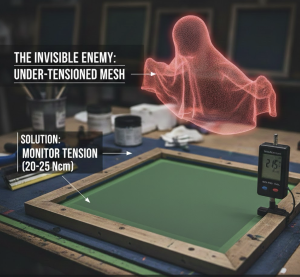 An under-tensioned mesh is the invisible enemy of print quality. When the mesh is too loose, the emulsion layer becomes inconsistent, leading to irregularities in stencil thickness and ink deposit. In high-resolution work, this can cause halftone dots to close, fine lines to blur, or details to wash away.
Solution: Always monitor mesh tension with a calibrated tensiometer. For most textile applications, a stable range of 20–25 Newton/cm is recommended. Where possible, use retensionable frames to maintain stability over time. Remember: A properly tensioned screen guarantees not only sharper prints but also longer stencil life.
- Incorrect Emulsion Over Mesh (EOM)
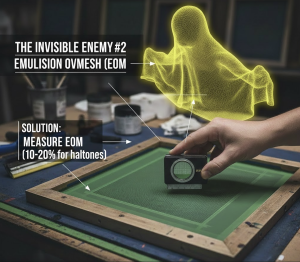 Emulsion Over Mesh, or EOM, defines the thickness of emulsion relative to the thread diameter. Too much emulsion leads to heavy ink deposits, loss of detail, and drying issues; too little emulsion results in fragile stencils that break down quickly on press.
Solution: Measure EOM using a film gauge or spessimeter. For halftone printing, aim for 10–20% of thread diameter, while for blocky spot colours or high-density inks, a higher percentage may be required. Use consistent coating techniques, dual-sided coating or controlled automatic coaters to achieve reproducibility. The key is not guessing but measuring.
- Wrong exposure time
 Perhaps the most widespread mistake: assuming ‘one-time fits all.’ Overexposure hardens the emulsion too much, making washout difficult and potentially reducing stencil resolution. Underexposure leaves unpolymerised emulsion, which softens during printing and collapses after a few runs.
Solution: Calibrate exposure with a step wedge or exposure calculator. Every emulsion, mesh count, and coating thickness requires a different exposure time. Environmental factors – temperature, humidity, lamp age – also matter. Establish a standard operating procedure: record times, mesh data, lamp hours, and test results. Precision here saves frustration later.
- Inadequate light source
 Not all light is equal. Many shops switch to UV LED systems for energy efficiency, but neglect to adapt exposure parameters. Conventional metal halide or fluorescent lamps emit broader spectra, while LEDs may lack penetration for certain emulsions or thick coatings. Poor lamp maintenance further reduces efficiency, leading to weak stencils.
Solution: Match the emulsion to the light source. SBQ photopolymer emulsions are highly reactive to LED, but diazo-based emulsions often require broader UV spectra. Clean and recalibrate lamps regularly, monitor output with a radiometer, and replace ageing bulbs before they cause quality loss. Exposure is chemistry meeting physics; light must be precise.
- Poor washout and post-exposure practices
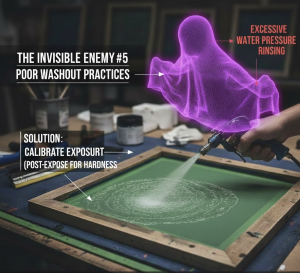 Even after perfect exposure, mistakes during washout can destroy a stencil. Excessive water pressure can undercut edges, while insufficient rinsing leaves residue that clogs halftones. Skipping post-exposure reduces chemical resistance, making the stencil vulnerable to aggressive inks or cleaning agents.
Solution: Standardise washout pressure and distance, ideally between 2–3 bar for textile screens. Always use clean, filtered water. After developing, dry completely and perform a short post-exposure to increase hardness and solvent resistance. This step is often overlooked, yet it greatly extends stencil life.
Conclusion
Exposure errors are not just technical inconveniences – they are profit killers. A stencil that collapses mid-run, or a halftone that prints inconsistently, forces reprints, wastes ink, and erodes customer trust.
The solution is discipline: measure, calibrate, record, and repeat. Exposure is not guesswork; it is a controlled scientific process. By eliminating these five common mistakes, screen printers can achieve sharper detail, stronger stencils, and more predictable results. As the saying goes: print quality begins long before the press – it begins with the screen itself.