 Printwear & Promotion The Total Promotional Package
When deciding on the best ink, it all comes down to how you want the end result to look. Each one has its merits and faults, so to help guide you through, Beppe Quaglia, CEO and founder of Virus Inks, has offered some helpful tips to make the best decision.

In textile screen printing, ink is more than just colour on fabric; it’s the physical medium that defines hand-feel, durability, compliance, and even energy consumption.
For experienced printers, the challenge is not whether to use plastisol or water-based, but how to make the right choice for each specific job. Every print run involves balancing speed, effect, sustainability, and customer requirements. The ability to select the correct ink system is what separates good printers from great ones.
Plastisol inks: Productivity and stability
Plastisol has been the workhorse of textile screen printing for decades. It is stable, easy to print, and forgiving on press. Because plastisol does not dry in the screen, long runs are safer with less downtime. Its opacity is excellent, making it ideal for printing on dark garments.
Advantages: Unmatched productivity, wide process window, high coverage.
Limitations: Plastisol requires heat cure, leaving a heavy hand and limited breathability. Environmental compliance is also an increasing concern, with many brands reducing or banning PVC-based formulations.
When to choose: High-volume production, sportswear logos, or when consistency is more critical than hand-feel.
Water-based inks: Soft hand and eco credentials

Water-based inks are increasingly seen as the future of textile printing. They deliver a soft hand, vibrant colours, and are compliant with major ecological standards. Modern high-solid acrylic (HSA) systems have solved many of the problems of older water-based formulations, offering improved opacity and wash fastness.
Advantages: Breathable prints, fashionable soft touch, environmentally friendlier chemistry.
Limitations: Greater sensitivity to drying in the screen, higher demands on mesh preparation and curing. Printers must manage humidity, screen tension, and drying capacity more carefully.
When to choose: Fashion printing, retail-quality garments, and eco-conscious projects where brand compliance demands PVC-free inks.
Discharge inks: Vintage and true fabric feel
Discharge inks chemically remove the garment dye and replace it with pigment, creating designs that feel like part of the fabric. The result is an ultra-soft, vintage-style print that cannot be replicated with plastisol or standard water-based systems.
Advantages: Unparalleled hand-feel, bright colours on dark cotton garments, no ink build-up.
Limitations: Limited to 100% cotton fabrics, results vary depending on fabric dye, and shelf life is short once activated. Discharge also requires careful ventilation and compliance monitoring.
When to choose: Fashion and streetwear markets demanding vintage aesthetics, large, solid areas without ink film.
Specialty inks: Effects that stand out
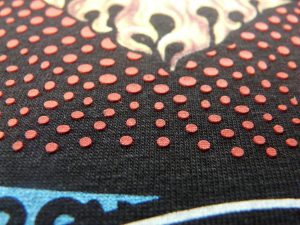
 Beyond standard systems, specialty inks open creative possibilities. Metallics, high-density gels, puff additives, luminescent pigments, or conductive inks expand screen printing into new markets. These inks require precise mesh selection, stencil thickness, and curing control to achieve reliable effects.
Advantages: Unique textures and visual impact that cannot be matched by digital printing.
Limitations: Slower printing, higher cost, and greater risk of defects if not handled with expertise.
When to choose: Premium designs, special editions, fashion highlights, or technical garments with functional effects.
Making the right choice: A practical approach
Selecting inks is not about choosing ‘the best’ system, but the most appropriate one for the task. Consider:
- Substrate: cotton, polyester, blends, performance fabrics.
- Design requirements: halftones, solid fills, or special effects.
- Production environment: drying capacity, climate, operator skill.
- Brand compliance: sustainability certifications, restricted substances list.
- Customer priorities: cost, feel, durability, ecological values.
 A simple decision tree can help. If the job is mass production with limited fashion requirements, plastisol remains efficient.
If the project is eco-driven, water-based is the natural choice. If the client wants a vintage look, discharge is unmatched. And if the goal is differentiation, specialty inks provide unique value.
Conclusion
Inks are not interchangeable commodities; they’re strategic tools. A successful screen printer must master not only the technical handling of each system, but also the judgment to know when to use which. There is no single ‘right’ ink for all situations. The right ink is the one that matches the fabric, the design, the brand requirements, and the client’s vision. By making informed choices, printers can optimise production, improve compliance, and deliver results that elevate both the craft and the business.