 Printwear & Promotion The Total Promotional Package
In this column, Beppe Quaglia, founder and CEO of Virus Inks, gives 10 tips on how to make the most of DTF printing.
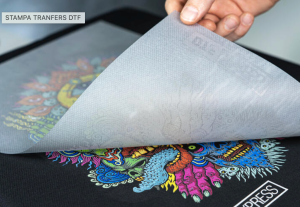
DTF printing is widely regarded as one of the most significant revolutions in textile customisation in recent years.
Yet, as with every technology that spreads quickly, initial enthusiasm leads operators to underestimate the process’s complexity, resulting in mistakes that affect the quality of the product and the profitability of the business.
The truth is that DTF is not a plug-and-play system, every phase is a potential critical point.
- The right film matters
Not all PET films are equal, and the wrong choice is costly. Ink may fail to adhere properly, develop microcracks, or transfer unevenly onto fabric. The market now offers “easy-peel” and “hot-peel” variants to suit different fabrics and workflow speeds. Investing in certified films is not a luxury – it is the foundation for stable, repeatable results.
- Adhesive powder: Give it time
Applying powder when the ink is still too fresh leaves visible craters that compromise the print’s aesthetics and durability. The ink must gel superficially before the powder is distributed. Uniform coverage – whether through a well-managed manual sieve or an automated shaker – is essential for a perfect fusion.
- Balancing of time and temperature
Blindly trusting the values declared by film or ink manufacturers, without verifying that your heat press actually reaches those temperatures, is a dangerous error. A few degrees of difference can compromise adhesion, leading to prints that peel or crack after a few washes. Infrared thermometers and periodic process checks are the mark of a true professional.
- Colour fidelity wins customers
Without a calibrated colour workflow, reds turn dull, blues shift towards unwanted tones, and blacks lose depth. Dedicated ICC profiles and correctly regulated ink density are essential. Modern RIPs with AI algorithms compensate in real time for dot gain variations, drastically reducing the number of tests required.
- More ink does not mean better quality
Increasing ink density in the belief that it guarantees greater coverage often produces curled film, excessive drying times, and compromised transfers. The secret lies in balance: Calibrate print curves to the film type and monitor environmental conditions constantly. Humidity is a silent enemy that warps the substrate and alters ink deposition.
- Maintenance as a professional culture
An uncleaned print head, a worn roller, a neglected aspiration system – all undermine production consistency. Keeping a log of interventions, scheduling daily cleanings and weekly checks is not wasted time; it is an investment that prevents costly machine downtime.
- Transfer deserves proper attention
10 seconds of pre-pressing eliminates wrinkles and residual moisture. Consistent pressure guarantees complete adhesion, and cooling – especially with cold-peel films – is essential to avoid detachment. A second pressing with a Teflon sheet improves fibre fusion and eliminates the unwanted “sticker” effect.
- The trap of inferior materials
Uncertified inks, powders, and fabrics represent an apparent saving that quickly becomes a loss of credibility and margin. The most encouraging trend in recent years is the rise of high-speed water-based inks – more environmentally friendly and capable of excellent results. Ignoring this shift means losing a genuine competitive advantage.
- Customer feedback as a growth tool
Every return and every complaint are opportunities to improve. Ignoring feedback is equivalent to repeating the same mistakes. The most forward-thinking companies integrate CRM systems connected to production, capable of collecting defect data and suggesting targeted corrections.
- Keeping pace with change
DTF evolves at an impressive speed. New films, powders, automated systems, and intelligent software are continuously redefining the sector. Attending trade shows, workshops, and online communities is not optional – it is a necessity for anyone who wishes to remain competitive.
Conclusion
DTF printing is far more than a passing trend. To fully exploit its potential, however, it is not enough to purchase a printer and a few rolls of film. Technical knowledge, attention to detail, and a genuine willingness to keep learning are all required. The professional who masters this process will not merely be an operator, but a contemporary craftsman – and it is precisely this combination that makes the difference in an increasingly competitive market where quality and reliability are the true keys to success.